
Why Research Agility Is the Most Important AI Metric You’re Not Tracking
Tim Peters gave us two key aphorisms in The Zen of Python:
Simple is better than complex
and,
Complex is better than complicated
Both of these are still true, and in our experience, when it comes to machine learning infrastructure, most of it lands squarely in the “complicated” bucket.
It’s not that it’s intellectually demanding — not necessarily. It’s more that it’s painfully fiddly and finicky, and using it means you have to keep and hold a dozen irrelevant technical details and obstacles in your head just to do basic research.
Compute is always finite, and so every lab naturally curates. Good researchers get exceptionally good at calculating which experiments make the cut, and which don’t. The expensive casualties in any lab aren’t the experiments that don’t get run; the filtering itself is a good thing, separating the good from the bad. The casualties are the ideas that researchers don’t let themselves have in the first place, because engaging with them would mean weeks of infrastructure wrangling before anyone gets to learn a thing.
If they’re major experiments — the ones that teach us the most — they usually take up a massive block of GPUs, an untested training script, and a week of undivided attention. When your resource scheduler is awkward, the environment configs work on one node and crash on the next, and your orchestration tools are fragmented, your infrastructure starts to make decisions for you — starting with which questions get asked and which are deemed too hard to investigate.
Sooner or later, your infrastructure starts setting your research agenda.
At Hop Labs, we measure this as Research Agility; and it might be the most important metric in your organization.
The language of the idea and the language of the tools
The metric for research agility isn’t speed — we’ll get that out of the way early. Anyone can chop faster with a dull knife if they simply use more force, but the result is messy, the effort is exhausting, and you run the risk of losing a finger. A sharper knife, wielded carefully by someone who knows what they’re doing, fades into the background and lets you focus entirely on the work instead of the tool. We find research agility works the same way; when you optimize for it, the tools stop fighting you, and you’re empowered to do the research and the work that will move the needle.
The clearest example of this is language. Researchers operate in the language of experiments: hypotheses, tests, and results. But executing on those ideas means translating them into a completely different language: engineering. You have to think and talk in job queues, container images, and driver versions. The cost of an idea is whatever the cognitive distance is between the two languages.
When the cognitive distance is short, a researcher can test a new concept in an hour; when it’s longer, when they have to painstakingly translate every thought and every action before a test can begin, they lose time and worse — they risk errors. It’s the dynamic that explains Python’s organic dominance in research: Python lets scientists stay rooted in their own language much longer than an option like C++ — without permanently closing the door to other options when raw performance is needed.
What a scarce budget of ideas does to a researcher
If you constrain a researcher to two experiments per year, they’ll pick the safest ideas on the board. They have to; they can’t afford to spend time and resources following threads that might lead nowhere. And when a performance review or a publication deadline demands researchers show results, they won’t risk a year of progress on a hunch.
But if that same researcher is given the bandwidth and the resources to test twenty ideas, the entire dynamic flips; they can safely dedicate a few slots to pure, high-risk experimentation — the ideas that have the potential to change entire industries.
Some of the early work on language models is a good example. In 2016 and 2017, language was a side project at OpenAI while the lab’s visible bets went to reinforcement learning. Alec Radford’s first serious attempt, trained on Reddit comments, reportedly went nowhere; the one that worked, trained on Amazon reviews, produced its best result by accident — a single unit in the network that tracked sentiment and beat the supervised state of the art — but the field wasn’t impressed. GPT-1 appeared as a preprint in June 2018 and was overshadowed by Google’s BERT within four months; the scaling laws that made the bet legible as an engineering plan didn’t arrive until 2020.
Imagine if those researchers were bound by traditional performance reviews, needing one guaranteed win to survive the year. If they only had the capacity for a few well-scoped experiments, they would have likely retreated to safe, incremental baselines; after all, no rational researcher spends their limited capital on a bizarre, byte-level model of Amazon reviews. Under a rigid system, the breakthrough never happens, and history never records that it was even possible. A failed experiment leaves a trace; an experiment never attempted leaves nothing.
When a lab’s Research Agility is low, the constraints might not be articulated, but the researchers feel them all the same. They know how difficult, how annoying, and how complicated every experiment is going to be; and when they consider the limitations of their tooling, their budget, and their own time, their options start to dwindle.
Why safe experiments are the most expensive ones
High-confidence baseline runs teach you the least, which is what high confidence means. You run them to be thorough, to make sure you haven’t missed something obvious or shot yourself in the foot. You aren’t running them to be surprised.
Even when the ambitious experiment does get queued, fifteen days of fighting cluster bottlenecks is long enough for a researcher to lose the thread of their own reasoning. The field moves quickly, and by the time results land, they’ve had five other ideas and context-switched through three other projects. Then, because experiment tracking is disjointed and imprecise, they have to reconstruct the hyperparameter configuration and the chain of reasoning that produced the hypothesis before they can even read the evaluation metrics.
You can’t buy your way out of this with raw compute or even with more headcount.
You need infrastructure where testing an unproven idea is so cheap and effortless that it falls completely off the radar of things you need to manage or meter. It shouldn’t be a zero-sum game where an interesting experiment eats the bandwidth for a safe one; you should have the capacity to do both easily. Launching a test should feel as instant and low-stakes as checking a route on Google Maps just to see how long it takes, and require no justification beyond “it seemed interesting”.
The arithmetic
Doubling your team’s output is the thing every executive wants and can’t have. Hiring for it costs a fortune in salaries, burns nine months on recruiting, and then drops expensive new people into the same fifteen-day bottleneck that’s already suffocating the team you have.
Upgrading the productivity of your existing team is a far more realistic target. We’ve seen teams reach 8x and 10x throughput when the infrastructure gets out of the way. But you don’t need those numbers. A 4x improvement changes the company’s trajectory on its own; it lets you go from shipping a new model a month to shipping one every week.
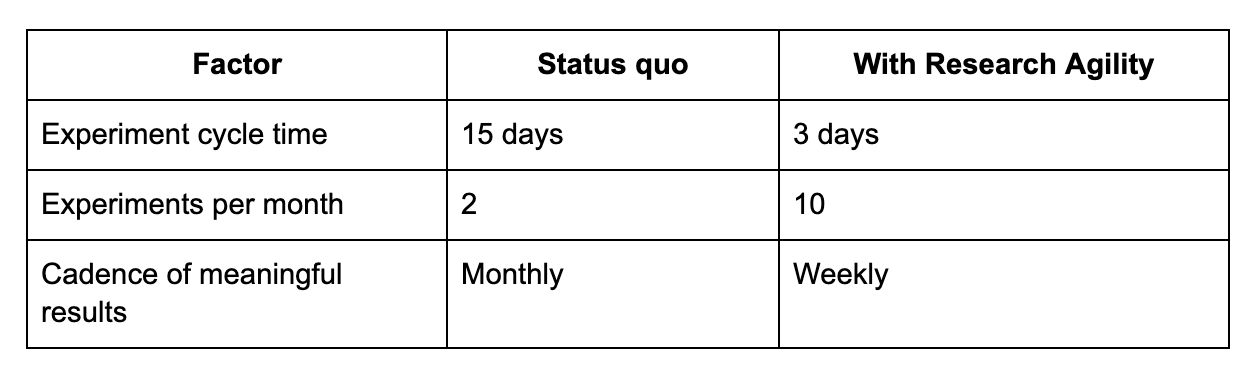
Massive productivity leaps happen the second tools fade into the background. Managing cycle times and babysitting shared clusters is necessary work, but it belongs to the system, not the scientist. Without that boundary, researchers spend their days wrestling with CUDA driver conflicts, writing custom job queues, and fixing dependencies that break the moment they hit a new node.
Whether it’s a ten-person startup or a thousand-person enterprise, VPs tell us the same thing:
Our researchers are technical; they’d prefer full access to set up their own clusters.
They probably can, but that creates two distinct problems.
First, because computational researchers often see themselves as technologists, they absorb the extra workload without complaint. Second, because most have never experienced proper research tooling, they don’t know what to aim for. The fact that someone can create a masterpiece with sidewalk chalk doesn’t mean chalk was the optimal tool. You hired them for the art, not the struggle.
Engineering for a product is also vastly different from engineering for research — not necessarily in skill, but absolutely in priorities.
Product infrastructure needs predictability, uptime, concurrency, and clean rollbacks. Research infrastructure needs flexibility — the freedom to rapidly test the unplanned. Forcing a standard deployment pipeline to act as a research experiment scheduler creates a compromised system that ultimately fails both sides.
Objections we hear
“Won’t a paved road limit them?” It can, and that’s the standard failure for platform teams. Building for an imagined researcher produces an abstraction that fits nobody, and the team blames adoption instead of design. Treat internal tooling like a real product: Follow one actual experiment end to end, find exactly where the researcher gets stuck, and always leave a way to drop a layer down.
“We’re too small for a platform team.” You might be, and you shouldn’t hire one for the sake of it. But if nobody owns the stack, everyone suffers, and no one maintains it. Assign one dedicated owner before you try to hire a team.
“Does every lab need this?” No. Some organizations follow a path that is already well traveled. They build the recommendation system that their competitors already have, and the science is settled. Those teams need good tools for execution, but they don’t need much agility, because you’re not asking them to think of something new. The same is true of a team that shipped a model, met its target, and moved on. If there’s no active research effort, there’s nothing for agility to unblock.
“Our real bottleneck is evaluation.” That can be correct, and it’s useful to know. If you can only judge a model with live customers, or with subject-matter experts who are available twice a year, then that rate sets a ceiling. Do the arithmetic and find out how many models you can truly evaluate in a year. Then size the research team to that number. It’s better to find this ceiling first than to build a large team and let twenty candidate models sit in a queue. This is a design constraint, and you can plan around it. You can use off-the-shelf models where the leverage is low, or find a partner with more volume to test against.
“Won’t more agility make us reckless?” This question mixes agility with speed. Agility doesn’t give anyone permission to skip documentation, tests, or careful evaluation. The opposite is true. In a low-agility lab, this careful work is the first work to stop. Data set versions are hard to record, so nobody records them. Experiment results are hard to share, so they stay on one laptop. Good tools make the careful work cheap enough to do.
How to diagnose your own lab
Pain points are the wrong place to start; they only reveal the clunky workarounds for things your team is already doing. You need to uncover what they have completely given up on.
Ask your team the big, uncomfortable questions Richard Hamming famously posed in You and Your Research: “What are the big problems in your field? And why aren’t you working on them?”
Hamming found that asking these questions exposed latent assumptions that were holding people back. Today, if you ask a team why they aren’t working on something much more ambitious, the answer is rarely a lack of vision. It is almost always a technical barrier they have come to accept as an absolute law of physics. They are bound by stale limitations, having spent years training themselves to simply stop asking for what they assume is impossible.
When evaluating the reality of your infrastructure, abandon hypothetical questions. “How easy is it to ship a model?” gets you an idealized pitch about best practices. “How many models did you ship last year?” gets you a hard number and a much more useful piece of information.
That number won’t compare across organizations — a model a day is correct for some problems, and a model a quarter is correct for others. But it compares well against yourself.
Are you shipping more this quarter than last quarter? Are you exploring more ideas this year than last year?
A lab can be held to that.
Compute utilization is the metric to be most careful with, because it’s easy to measure and it’s widely reported. It tells you how much hardware a model used. It doesn’t tell you if the model works. It’s also a frontier-LLM measure that got adopted everywhere else by habit. Large labs report their compute in part to show how hard the work is, which discourages new entrants from trying. Scaling laws are real, and they matter if you train frontier models. Most teams don’t. If you look at where AI generates the most tangible value today, those models are rarely bottlenecked by compute. Their true limitations are much more grounded: the availability of high-quality data, the clarity of the feedback loop, or — more often than we’d like to admit — whether they are aimed at a problem worth solving.
Time-to-result is a better measure, but it falls apart if you can’t trust the outcome.
To measure real momentum, you have to separate risk from uncertainty.
Risk is about your appetite; it’s a known probability you choose to accept or avoid. Uncertainty simply means you don’t even know the odds yet.
Because absolute certainty is at the end of a very long road, the metric you want to track is time to uncertainty reduction. A clear failure steps down the unknowns and clarifies the actual risk. A fast, shaky success just leaves you in the dark. How quickly your team can reduce uncertainty to reveal an idea’s true risk profile is the best measure of your momentum.
You can back this up with two secondary measures. First, monitor time allocation: the hours researchers spend acting as system admins and wrestling with infrastructure should naturally trend toward zero.
But removing infrastructure friction isn’t enough on its own — which brings us to the second measure: tracking top-of-license work.
If a PhD isn’t debugging a cluster, but is instead manually cleaning datasets or managing pipelines, they are still doing work entirely below their license. The goal is to eliminate both the infrastructure hurdles and the mundane busywork so they can do the science they were hired for.
One final signal. Researchers of a similar level talk to each other, and most of them want the same thing: to do good work with good people. A good salary and a recognizable brand will get you into the conversation, but after that, the amount of nonsense a person has to deal with each day starts to compound. If your team won’t hire from their own networks, the tools are worth a look to understand why.
What to do this week
Measure idea-to-certainty latency. Pick one recent experiment and count the hours from “I wonder if” to “I know whether”.
Shadow one researcher for a morning. Don’t ask what they’re working on; watch what they actually do. An afternoon lost to dependency conflicts is a tooling problem, not a discipline problem.
Pick one escape hatch. Find the place where your stack fights hardest and give researchers a way around it, even if the fix is imperfect.
Practice being ambitious. Ask yourself what the big career-defining problems are in your space. You don’t have to work on them or even enumerate the obstacles — this week, you just need to get in the habit of thinking bigger your current roadmap.
The state of tooling across this industry is bad enough that a handful of deliberate improvements will make your lab one of the better places in the world to do this work.
There are two ultimate goals you should aim for:
Your lab should be the place where researchers do the best work of their careers, and
Your tools should never be the reason a bold idea goes unexplored.
Take a hard look at your current setup this week. Ask your team what they aren’t trying because it’s simply too hard, and start dismantling those barriers today.